The short version: if you’re not an EU citizen and don’t have residency anywhere in Europe, you can buy a car, but you run into a snag when you try to register it. No registration means you can’t insure it or drive it legally.
Germany has a workaround though, through a company that acts as the registered holder of the vehicle on your behalf while you remain the legal owner. The company is called CarTurf and I used them for this exact process.
I bought a car for €4,200 (about $4,855 USD) and had it registered, insured, and on the road in under a week, without EU citizenship, without a European address, and without speaking German! This post covers the costs, the documents you end up with, and how the process went for me, start to finish.
Is CarTurf legit?
The short answer: in my experience, yes. I went in a bit skeptical: it’s a small, relatively new company asking you to hand over money and trust them with a foreign vehicle registration before you’ve met anyone in person. BUT, I was also desperate, so I trusted the process.
I did a fair bit of due diligence before signing up (see “Why CarTurf, and not something else” below), had a lengthy call with the founder before committing to anything, and everything since then has matched what I was told upfront. I’m just one data point though, so please do your own research too. But if you’re here because you searched some version of “is CarTurf a scam,” this post is my detailed answer: no, not from what I’ve experienced.
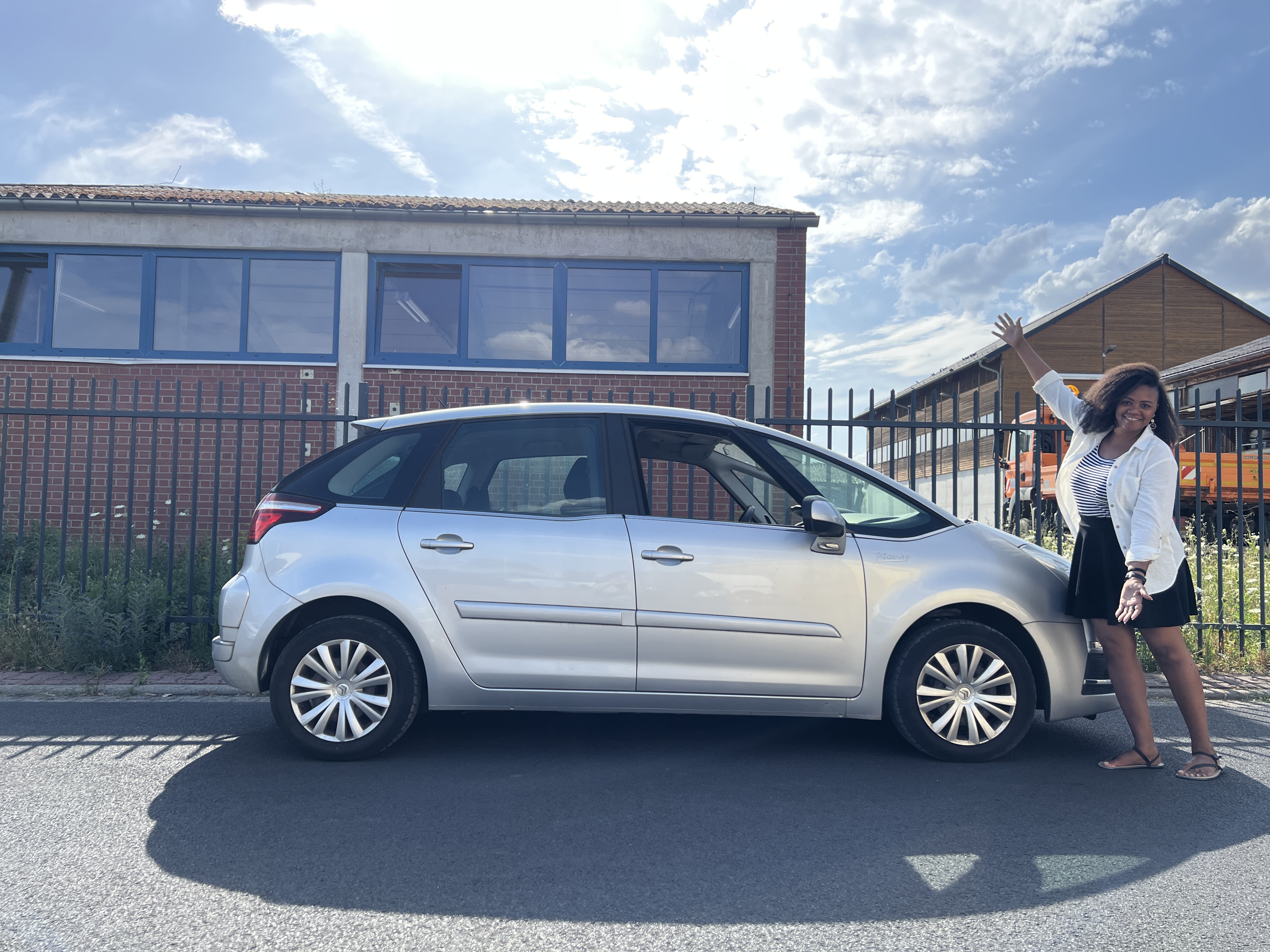
It’s a Friday morning, (just 5 days ago I was in Japan), and now I’m sitting in a used car dealer’s office in Frankfurt, using Google Translate to chat with him as we sort out the final details.
I’ve got WhatsApp open on my phone, sending photo after photo of documents to a guy named Alex at CarTurf. “Does this all look in order? Is this everything you need?”
Typing… appears, then his final reply: “Yes, that’s everything.” Perfect.
I hadn’t bought a car in over fifteen years, never outside the US, and definitely never in a language I don’t speak. But there I was, signing off on a contract that was little more than a one-page form (probably typed up in Microsoft Word a few decades ago by the dealer’s uncle and still being used today), handing over the second half of the cash, and shaking hands with the dealer.
What CarTurf is, and why they exist
I first heard about CarTurf from a woman on YouTube named Sherry Jo Wilkins. I was deep into a van-life video binge one night when she mentioned how she, an Australian citizen, had bought a motorhome in Europe through CarTurf.
They’re a company based in Germany that helps you register a vehicle even if you don’t live in Europe, don’t hold EU citizenship, and don’t own property there. Normally, if you want a car in Europe, whether that’s a second vehicle for road tripping or a full-time setup like mine, you’re stuck, because registering a vehicle requires some version of citizenship/residency. CarTurf solves that.
I got more of the story straight from the founder, Marcus, on a call. He’s American, and years ago he bought a car in Germany himself and found the whole process a real pain.
There wasn’t a service like this at the time, so in 2023 he started one. He built it with Americans, Australians, and British travelers in mind: people who come to Europe for a month or two and get hit with insane rental car costs, people who want to travel with pets (which most rental companies won’t allow), and people who spend several months a year in Europe and find it’s simply easier to own a car outright.
And then, of course, there are digital nomads like me, for whom a car means the freedom to move from place to place on a never ending road trip.
Why CarTurf, and not something else
Originally, I assumed as an American that this dream would be off the table entirely, thanks to visa and residency rules. Everywhere I looked, it seemed like you needed to own property and be a resident.
When I finally tracked down a few companies that would work with someone in my position, each came with its own restrictions. One, based in the Netherlands, sells you a motorhome and then insures the vehicle they sold you, but that wasn’t the route I wanted.
After nearly a decade without owning a car, and with Europe’s tiny streets in mind, I wanted something small and flexible that could fit almost anywhere! I’d also become a bit obsessed watching YouTube videos of people living out of minivans in the US, and figured something that size would suit my lifestyle well.
I also reached out to a company called mygermancar.com. They told me they only handle this process for cars €25,000 ($29,000) and up. That ruled them out immediately. I was after what I affectionately call a “beater,” an old, unglamorous car that could get me from point A to point B, nowhere near that price range.
When I sent CarTurf my initial list of questions, they told me they had no price floor at all. They’d worked with plenty of people who bought something for a few thousand euros just to use for a season and then sell. That’s when I knew they were my kind of company. (My car ended up costing €4,200, about $4,855.)
Getting set up before I even flew out
I pored over CarTurf’s website and every FAQ they had, because I genuinely couldn’t wrap my head around how this would even be legal. What if I got pulled over? Did I actually own the car if someone else handled the registration? How would insurance work? Would they help me find the car, or was I on my own?
The site looked legitimate, and I had the YouTuber’s firsthand account to go on, but I still wanted to talk to an actual person.
I sent their customer service team a long list of questions. They answered quickly, and when I had even more questions, they suggested I jump on a call with the founder, Marcus, who could answer anything I still had doubts about.
This was about two months before I actually planned to buy. I was living in Japan at the time, slowly coming to terms with the fact that it was time to turn this from an idea into a plan.
One thing worth knowing: you don’t need to do anything with the company until you’re close to actually buying. That said, reaching out early is completely fine, and I’d recommend it. Buying a car in a foreign country, with a fair bit of money on the line is a big decision, and CarTurf is happy to answer questions well ahead of time.
On the call, Marcus walked me through the general process. The car-buying part is entirely up to you, though if you want help, they can check whether any of their existing customers are selling something around when you’re buying, or they can help to call dealerships on your behalf and set up appointments if the seller doesn’t speak English.
(This should come as no surprise if you know me, but my ADHD didn’t leave much room for that kind of help.
I did the entire car-buying process in frenzied three and a half days, in a mix of German, broken English, and Google Translate, because I simply didn’t have the patience to loop CarTurf in.
I suspect most of you will have a much smoother time using their help if you go in without my (personally set, totally insane) time-line, so if you do, email me and tell me about it. I’d love to add it to this post.)
If you want to see and test drive the car in person, it helps to research ahead of time so you can shortlist makes and models before you land and you can use CarTurf to preset appointments. That alone cuts down significantly on the time you’ll spend running around once you’re there. If you’re not sure exactly what you want, Marcus suggested to plan for a week to two weeks of shopping.
Once you’ve found a car, signed the contract, and made the payment (which, depending on your bank, can take one to three days to clear), the dealership hands over the documents.
From there, you have two main options. 1) mail the documents to CarTurf’s office and let them handle the registration remotely, which takes about four business days, or 2) drive the documents over yourself if you’re in the area, in which case they can often register the car that same day or the next morning.
There is a 3rd option depending on the age of the vehicle’s paperwork. If the car’s documents were issued after 2015, they include digital codes, and CarTurf can register the car online with plates printed locally the same day.
If the paperwork is older, especially if the car hasn’t changed ownership or been re-registered since around 2013–2015, they’ll need the physical documents and a trip to the registration office in person.
I also asked Marcus for any guidance on where in Germany to focus my search. In US states, some regions are dense with dealerships, so you head to one town and you’re spoiled for choice. I wasn’t limited to a single area, and I was happy to go almost anywhere in Germany.
My budget was under $10,000, ideally closer to $5,000, and I was looking for something SUV- or minivan-esque. Marcus explained that at that price point, you’re mostly dealing with trade-ins that are out of manufacturer warranty, and those are scattered across the country with no real predictability.
A denser population center does raise your odds, though. CarTurf is based between Cologne, Düsseldorf, Bonn, and Frankfurt, roughly a two to two-and-a-half hour drive between any of those cities, and that whole corridor is a solid bet for this price range. It also makes registration easier once you’ve bought.
That made the decision easy. I flew into Frankfurt, mostly because it was the cheapest German city to reach from Okinawa, where I was at the time.
As for payment, you don’t need a German bank account. Most people pay the dealer either in cash or by bank transfer, and Wise or Revolut are the go-to options, since Wise is essentially instant to a European IBAN account and Revolut takes a couple of hours.
Some dealers accept cash outright, and at the lower end of the market, under about $5,000, every dealer I spoke with only wanted cash.
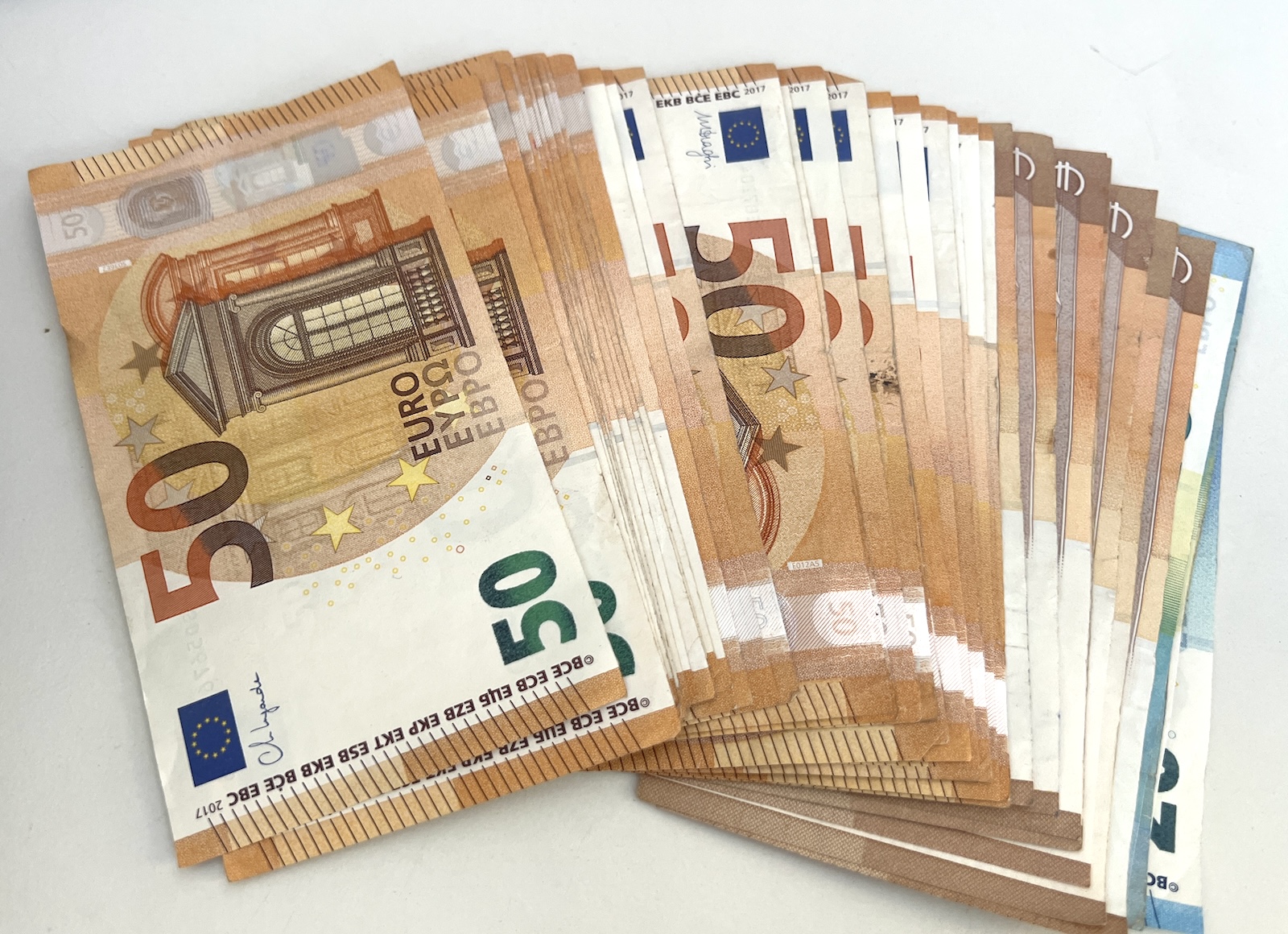
(I paid €4,200 for my car entirely in cash, which meant contacting my bank two days in a row to raise my ATM withdrawal limit, several trips to a gas station ATM where I felt distinctly like I was conducting shady business, and finally counting out stacks of colorful cash onto the dealer’s desk. It’s just Monopoly money right?! What a life. That’s a story for another post.)
Getting the ball rolling
I waited until about a week before my flight to sign up with CarTurf, and once I did, everything moved smoothly.
As I mentioned before, you don’t really need to do anything until you’re ready to start shopping. Then, they ask that you’re a member before they help you with appointments etc.
I signed up on their website, paid the signup fee and first month, and I was in. Their portal is well designed, and onboarding walks you through uploading your passport and driver’s license. It also includes helpful driving tips for different countries, along with a small marketplace showing cars other members are selling.
From there, there was nothing to do but wait until I touched down in Frankfurt.
The actual costs
There are three separate ongoing costs to understand with CarTurf, plus one-off fees. Amounts shown in Euros and USD.
| Cost | Amount | Notes |
|---|---|---|
| Signup fee (one-time) | €249 ($288) | Paid when you sign up on their website |
| Monthly service fee (OR 👇) | €99/month ($114/month) | Charged for as long as the car stays registered with CarTurf |
| Annual service fee (paid up front) | €999/year ($1,155/year) | Equivalent to two months free versus paying monthly |
| Vehicle tax | €90–€200/year typical ($104–$231) | Based on emissions; CarTurf pays it and invoices you. |
| Insurance | Varies by make and model | See “How much does insurance cost?” below |
| Ticket or toll handling (optional) | Fine amount + $10–15 | Only if you want CarTurf to pay it on your behalf instead of doing it yourself |
The service fee works like this: you sign up on their site with a debit or credit card, pay the €249 signup fee, then €99 a month for as long as the car stays registered with them. If you’d rather pay for the whole year up front, it’s €999, which works out to two months free. This is essentially the cost of them providing the service for you. Yes, it’s ongoing. Think of it like the rental fee for your car each month only that’s a heck of a lot cheaper than what rental cars cost.
Insurance is its own animal, priced differently than you’d expect if you’re coming from the US, so it gets its own section below.
Vehicle tax is billed yearly and is based on emissions, generally €90 to €200 ($104–$231) for a typical passenger car with an engine in the 1.2 to 2 liter range. Mine was €189.42 ($219) for the first year. CarTurf pays it directly and invoices you; mine arrived as an email with a Stripe invoice attached, priced in US dollars.
If you’ve got something with a 5-liter engine, you’re looking at more like €400 to €500 euros ($462–$578) a year.
Carturf will also be notified of parking tickets, speeding tickets, and unpaid tolls. They are the registered party for the car. Given how complicated driving can feel here at times, I fully expect to miss a toll (eeek!) at some point.
Carturf will send a notification by email or through the portal. I can either pay the charge myself directly, or have them handle it for an extra fee, something like an additional $10 to $15 on top of whatever the ticket was, just for the hassle of them taking care of it.
How much does insurance cost? (The insurance surprise)
CarTurf doesn’t just register your car, they also arrange your insurance, which is genuinely wonderful, one less thing to manage on your own. The pricing, though, caught me off guard. It came out to considerably more than I expected given the price of the car.
Here’s the key difference from how insurance works in the US. American insurance is built around who you are as well as your car: your age (premiums typically drop once you’re over 25), your driving record, how many accidents you’ve had, whether you’re driving something boring & safe, or something flashy that you’re more likely to perform unsafe driving in.
Not in Germany. There, it’s based on the car itself, the make and model, and the accident history of other drivers in that same type of vehicle. So even though my Citroën is a small, entirely unglamorous car, nothing remotely sporty, the insurance still came out expensive (apparently other Citroën drivers just aren’t very good at this?).
It runs me around €1,500 ($1,700) a year, on a car that cost €4,200 ($4,855) total. That stings! Honestly, more than a little. But I keep reminding myself that between transportation and housing, living out of the back of this car is still saving me a substantial amount overall.
For the first month, coverage defaults to full while CarTurf negotiates your actual quote with the insurer.
About two weeks in, they emailed me a quote with three coverage tiers: liability only, partial, and full. I went back and forth with them a few times to get clarity on what “partial” actually covered, since theft and broken glass were mentioned, but I wasn’t sure whether “broken glass” meant just the windshield or every window, and whether “theft” covered the car alone or anything inside it too.
Here’s what I eventually learned that Partial Comprehensive (Teilkasko) coverage actually includes:
- Theft of the vehicle, and damage from attempted theft
- Fire and explosion
- Storm, hail, flood, lightning, and other natural events
- Collision with animals
- Broken vehicle glass, including the windshield and side or rear windows, cracked or shattered
- Short-circuit damage to wiring
- Damage caused by animal bites (martens, notably)
- Damage during transport by ship, under certain conditions
- Personal belongings inside the vehicle, up to €300, as long as they were out of sight and not visible from outside at the time of the theft
I went with this tier for the first year, planning to reevaluate later. I’ve got several ferry crossings ahead of me, I’ll be putting on a lot of miles, and the Citroën’s windshield is enormous and surely expensive to replace, so a bit of extra coverage felt worth the peace of mind. CarTurf also provides a full policy booklet, though it’s entirely in German. Thank goodness for translation tools.
Breakdown cover (what we’d call roadside assistance) is bundled into the insurance rather than something you manage separately. It covers you across mainland Europe, the UK, Ireland, and Iceland, with a few extra caveats for other countries:
- Morocco: up to three months, with travel dates submitted in advance
- Tunisia: same terms as Morocco
- Turkey (up to the Bosphorus Strait): a €75 monthly surcharge
Roadside assistance covers a tow up to €400, with typical wait times of two to four hours, which honestly isn’t bad compared to what I’ve experienced elsewhere.
Documents Checklist: What you walk away with when you buy the car
I’ll cover the full car-buying process in Germany in a separate post, but when I sat down at the dealership to close the deal, I walked away with five pieces of paper:
- Title Part 1
- Title Part 2
- The COC certificate — an official spec sheet for the car: make, model, fuel type, and a handful of other technical details
- The TÜV / HU — Germany’s roadworthiness inspection, legally required and typically valid for two years, confirming a shop has signed off on the car as safe to drive
- The sale contract
I’ll admit, I have some doubts about how rigorous that inspection actually is. My car’s brakes squeak, and she needed a full transmission replacement just three weeks later (but I still love her!). It’s hard not to wonder whether there’s a bit of an understanding between mechanics and dealers when it comes to signing off. I’m not fully convinced it’s an airtight process, but it’s what’s required, and there’s no getting around it.
Which brings us back to where this post started. I’m in the dealer’s office going through this with him, everything in German, running it all through Google Translate and Claude.
Part of me is almost thrown by how simple it actually is. This is a massive purchase to me, the beginning of a huge chapter, and yet it comes down to handing over cash and signing a single sheet of paper before the car is mine.
I sent photos of each document to Alex at CarTurf over WhatsApp so he could confirm everything was in order in real time. Once he gave the all-clear, I signed the contract, handed over the rest of the cash, and shook hands with the dealer.
What surprised me again, coming from the US, is that you don’t drive away with the car that day. Back home, you pay, get your registration and temporary plates, and drive off the lot in one visit. In Germany, registration is a separate step entirely, one you have to go handle elsewhere and then come back for. Having Alex walk me through this ahead of time helped, because in the moment it felt deeply strange.
Wait, I just handed you a stack of cash, and you gave me some paper, but you still have the car and the keys? What if I come back Monday and it’s just… gone? I’m in a foreign country, I don’t speak German, and this suddenly feels like a lot could go wrong.
(Nothing did.)
Getting it registered
CarTurf is based in Remagen, about an hour and a half from where I bought the car outside Frankfurt. I could have mailed the documents to them and gotten the documents and the plates mailed back, but I’d just flown in from Japan, bought a car in 3.5 days, and patience has never been my strong suit.
I’d rather drive four hours round trip than figure out how to mail things in Germany, so I decided to just drive up and hand the paperwork over in person.
I bought the car on a Friday. What I learned immediately is that the German government does not run on the efficiency I always assumed of German people.
The registration office closes around noon, seems to be open only about three days a week, and, from what I gathered, is universally grumbled about by anyone who’s had to deal with it.
By the time I had my paperwork together on Friday around 1pm, they’d already closed for the day, so registration had to wait until Monday.
Monday morning, bright and early, I drove out to Remagen. Alex met me at the CarTurf office, warm and kind from the moment I walked in. We chatted in the bright little office while he took my paperwork and made copies. He didn’t need copies of my passport or driver’s license, since I’d already uploaded those to the portal when I signed up.
He asked if I wanted to come along to the registration office or wait there. Between the jet lag, nearly a week of nonstop running around, and a two-hour drive still ahead of me, I chose to wait. It took maybe twenty minutes before he came back with my new plates.
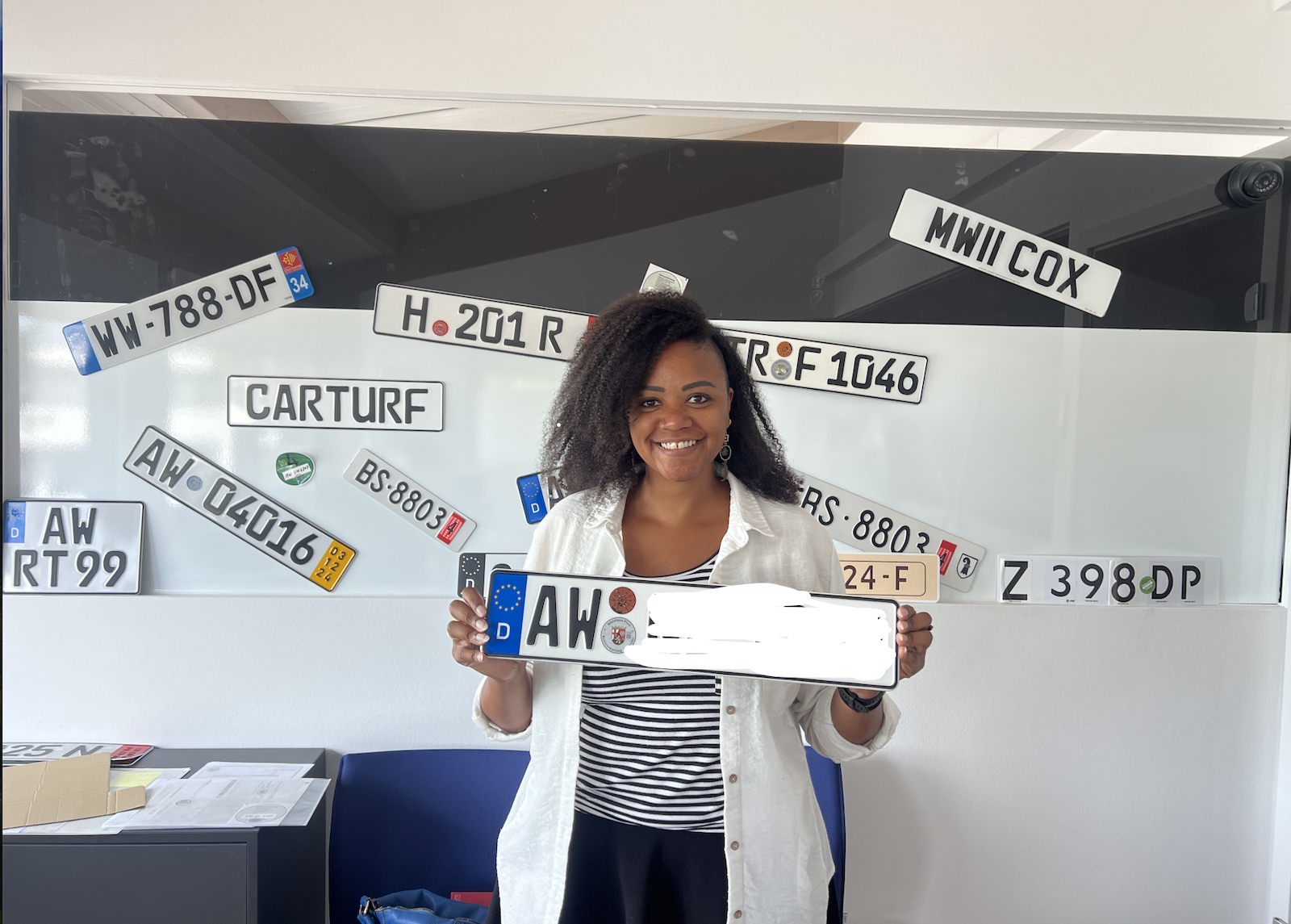
One fun detail about German plates: you get to customize part of them for free. In the US, some people pay extra for “vanity plates.”
In Germany, customization is baked in. The first two or three letters are fixed and represent the region where the car is registered; since CarTurf operates out of the Remagen area, your plate will start with AW, the code for the Landkreis Ahrweiler. After that, you choose two letters and up to four digits yourself, as long as the combination is available in that region.
Your plate ends up looking something like AW AB 1234, with everything after AW being yours to pick. You can check availability online ahead of time and have your favorite combination ready before you arrive
Picking something meaningful to me has already paid off more times than I expected, especially whenever I have to type my plate number in to pay for parking. Because I chose it myself, it springs to mind instantly while a random assignment would have taken much longer to memorize
Once Alex came back, we went over the paperwork one last time. There’s an official Title Part 2 that CarTurf keeps on file in their office, though I do have a copy of my own. I asked him about it directly, since I’d heard that whoever holds the title of a car in Germany is technically the owner, and I wanted to understand what that meant for me.
He explained that what I heard isn’t quite accurate, and that I’m still very much the owner and through his explanation I was also able to verify the details online.
Under German law, Title Part 2 (Zulassungsbescheinigung Teil II, sometimes still called the Fahrzeugbrief) isn’t proof of ownership. It’s an official government document, but its legal function is to establish who’s entitled to register or deregister the vehicle, not who owns it.
Ownership, under German law, is established the same way it typically is elsewhere, through the sale contract and the actual transfer of the vehicle. I became the legal owner the moment I handed over the cash, signed the contract, and the dealer handed me the keys.
Banks and leasing companies routinely hold onto Title Part 2 as security when a car is financed or leased. The bank isn’t the owner in a straightforward purchase, but holding that document gives them practical leverage, since a car can’t be sold or re-registered without it.
CarTurf works the same way. They keep a bit of leverage for the rare “just in case” situation; apparently a past customer once simply stopped paying and kept the car for a bit. Holding Title Part 2 means they can legally deregister a vehicle if that happens again, which would leave that owner driving an unregistered, uninsured car. As long as you stay on the up and up, none of this is anything to worry about.
That was that. I said goodbye to Alex and drove off with my new plates, Title Part 1, the COC certificate, a printed certificate of ownership, and a page with my insurance details.
Crossing borders with a CarTurf-registered car
Since I plan to drive this car all over Europe rather than park it in Germany, in my call with Marcus I asked directly about border crossings, and whether being American, and technically not the “registration holder” (CarTurf is), would cause problems.
According to Marcus, no. Surprisingly, they haven’t run into issues with other customers, and plenty of them have gone all over the continent.
On the road, authorities are checking three things: 1) is the car registered, 2) is it insured, 3) has it been reported stolen. Within the EU, that’s simple since any road authority can pull up the plates and check the EU database directly.
It matters more once you’re leaving the EU, heading into places like Albania, Morocco, or the UK. For that, you’ll want physical documents on hand:
- The sales agreement in your name
- Proof of payment, if you paid by bank transfer, showing you’re the financial owner
- Title Part 1
- The international insurance card (formerly the “green card,” now just a plain white page) listing every country your policy covers
On top of all that, CarTurf issues something called a Certificate of Ownership: their own document confirming you’re the one entitled to use the vehicle, in case anyone questions the relationship between you and the registered party.
So far I’ve only crossed over from the mainland to the UK via the Chunnel. The border guards on the UK side did ask if it was my car and you should have seen the smile break over my face as I proudly proclaimed, “Yes!”
They waved me over to the side, shone a light around in the back (its sort of kitted out as a mini camper) but they didn’t ask to see any documents or anything other than my passport, waving me on and through to take the train. I keep all my documents organized neatly in a plastic envelope and I’ve got scanned copies securely saved as well.
Selling or walking away from the car later
During that first call, I also asked Marcus what happens on the other end, if I eventually decide I’m done and want to sell, or even scrap the car.
Either way, the registration has to go through CarTurf. You can sell it yourself directly to a buyer. That’s just a matter of writing up a bill of sale, and CarTurf transfers the registration to the new owner, who can then either continue with CarTurf or register locally wherever they are in the EU, usually without extra fees for a used vehicle.
Or, if you’d rather not track down a buyer yourself, you can bring the car back to Germany and leave it with CarTurf, and they’ll list it for incoming customers who are just starting their own version of this journey.
So, my impressions?
Overall, as a company, it’s been a genuinely great experience from start to finish. The call with Marcus went really well, and I appreciated that he was willing to sit there and answer every single question I threw at him, in real depth.
I’m impulsive and impatient, once my brain locks onto something, I want it to happen immediately, but I can also spiral into fixating on strange, specific details, and he matched that energy without missing a beat.
Alex, who I met in person in Remagen, was just as lovely, encouraging and cheerful, and he left me a wonderful kind message wishing me luck as I set off.
The fact that I bought a car in a foreign country in under a week, got it registered and on the road, and that dealing with CarTurf was by far the easiest part of the whole process, says a lot. I’m hopeful this is the start of a long relationship with them. If things keep going this well, I can see myself keeping this car and driving her all over Europe for years to come. None of it would have been possible without this company existing.
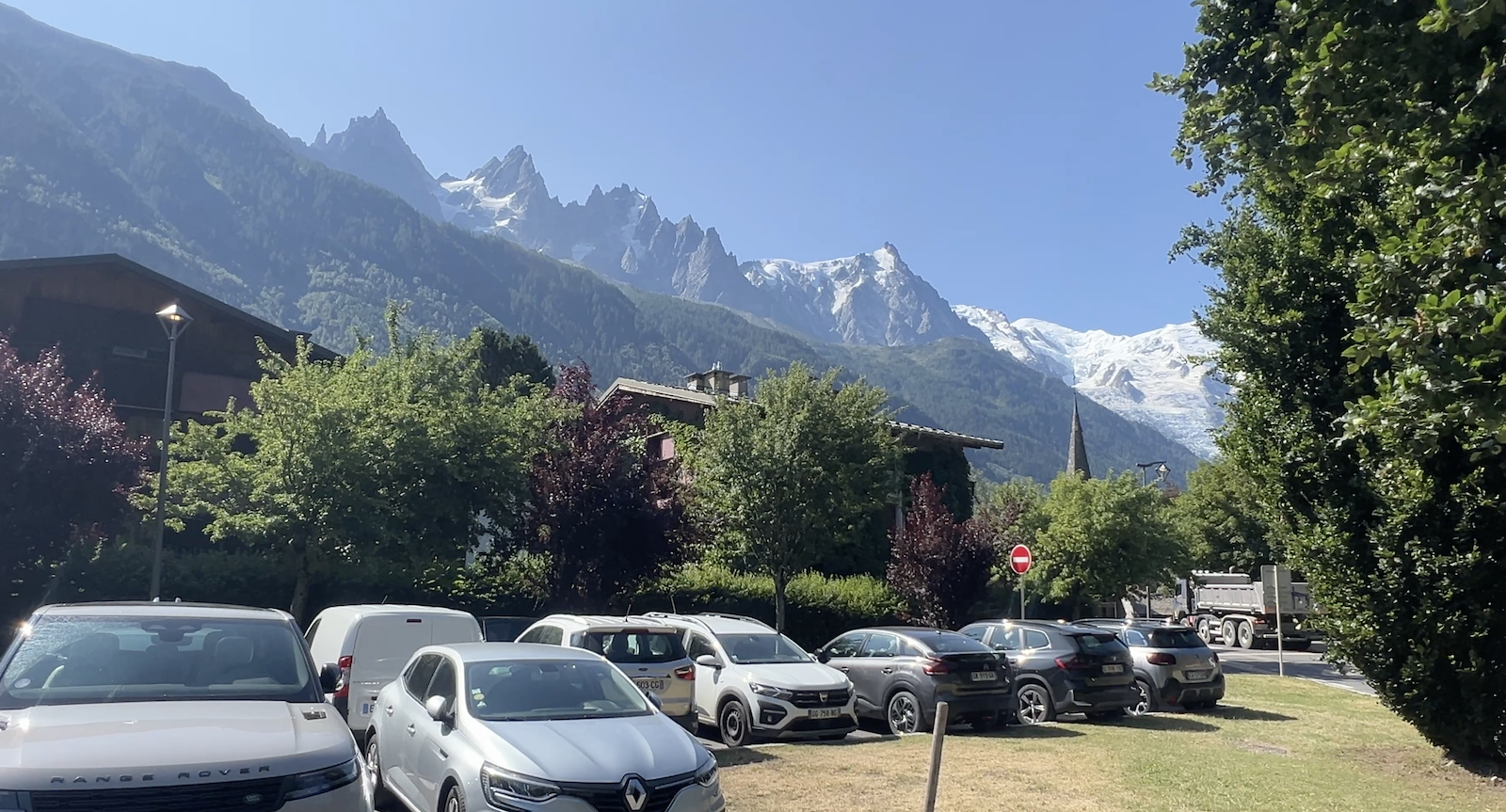 (Spent a night in a parking lot near Mont Blanc in Chamonix, France)
Today, as I post this, marks exactly one month since I flew back from Japan. In that time, I’ve left Germany, spent time with friends in Switzerland, headed south to Chamonix, and then made my way to the shores of Lake Como in Italy, where much of this post was actually drafted.
 (Spent a night in a parking lot on the shores of Lake Como, Italy)
Then, one Sunday, I woke up and decided it was time to head north. I drove up through France, booked the Chunnel train, and I’m now making my way through the UK, hoping to catch the northern highlands while the weather holds.
If you’re thinking about doing something similar, I highly encourage it. If you’ve got questions I haven’t covered here, reach out to me at mashon [at] liveworktravel.com, and reach out to CarTurf directly too; they’re genuinely happy to answer questions.
I plan to keep updating this post as the journey continues, so if you end up following in my footsteps and pick up details that could help other readers, please let me know.
Frequently Asked Questions
Is CarTurf legit? In my experience, yes. I bought a car, had it registered and insured, and have been driving it across Europe for a month with no issues. See “Is CarTurf legit?” near the top of this post for the fuller answer.
How much does CarTurf cost? €249 ($288) one-time signup fee, then €99/month ($114/month), or €999/year ($1,155/year) if you pay annually. On top of that: vehicle tax (typically €90–€200/year) and insurance, which varies by car. Full breakdown in “The actual costs” above.
Can Americans register a car in Germany? Not directly, since German vehicle registration normally requires residency. Companies like CarTurf solve this by registering the car under their own German entity as the “Halter” (custodian) while you remain the legal owner.
Do I need a German bank account to buy a car in Germany? No. Most dealers accept cash or a bank transfer through a service like Wise or Revolut, neither of which requires a German account.
Can I drive a CarTurf-registered car outside Germany? Yes. German plates are valid across the EU, and the insurance CarTurf arranges covers mainland Europe, the UK, Ireland, and Iceland, with additional terms for a few countries outside that. See “Crossing borders with a CarTurf-registered car” above.
What documents do I get when I buy a car in Germany? When you close the deal, the dealer hands you Title Part 1, Title Part 2, the COC certificate, a valid TÜV/HU inspection report, and the sale contract. You don’t need to have any of these beforehand; they’re part of what you receive at the point of sale, and they’re what you then pass along to CarTurf to get the car registered. Full details in “Documents checklist” above.