You can see Stonehenge for free, legally, and from surprisingly close. There are two ways to see it:
- A public byway where lots of vans and motor homes park overnight (2 ways to get here)
- Or simply through your windshield as you drive past.
The first time I visited Stonehenge it was courtesy of some local friends who generously took me along with them to have the whole experience.
Visiting them again some years later, I thought I’d stop on the way to see Stonehenge again … (“but if only it wasn’t so expensive!” I thought to myself).
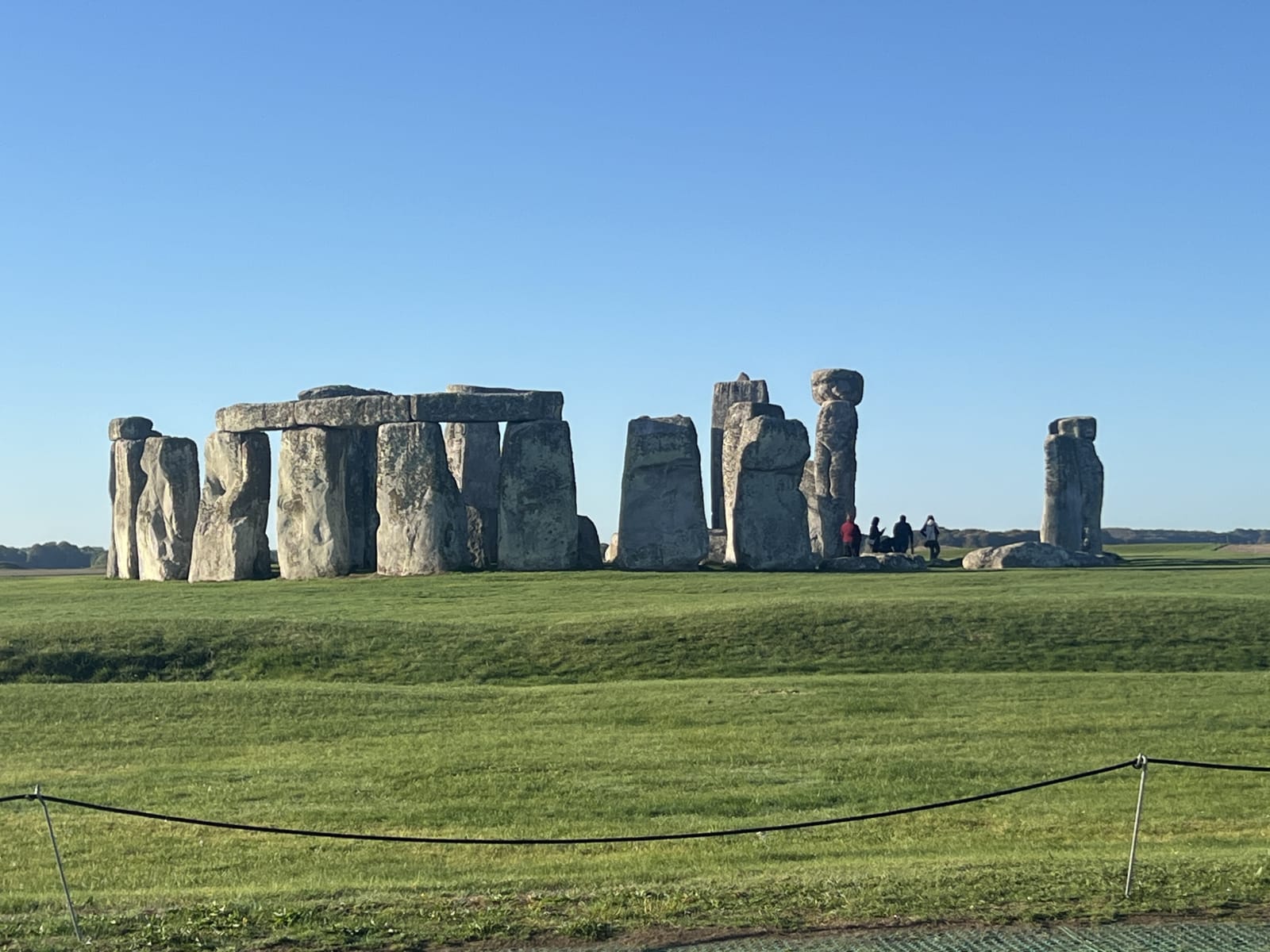
To my surprise, with virtually no digging at all, I found out there’s a public track running right past the stones, literally on the other side of the “reserved for paying customers” walkway.
And there’s free parking as well, where loads of people park their vans and wake up to a view of a 5,000-year-old monument for exactly zero pounds.
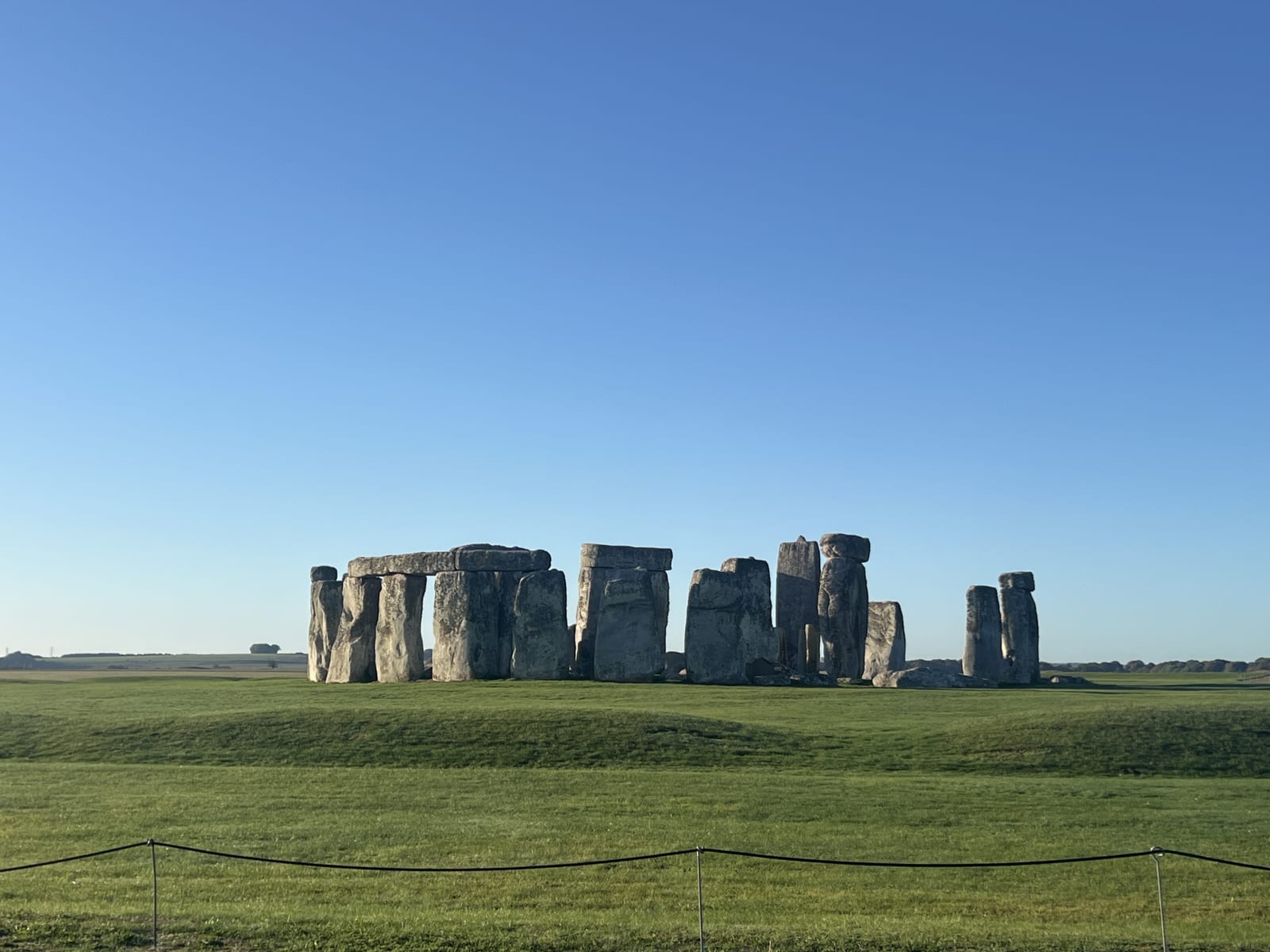
I mean, that’s a pretty good view of Stonehenge for free in my opinion. Taken with an old iPhone 13.
I highly encourage going first thing in the morning! Stonehenge opens at 9:30 but before that you get amazing views with almost no one around.
Before you go: check these first
The byway has been closed to vehicles before, sometimes for months at a time.
The track I’m about to describe is the Stonehenge Public Byway. Wiltshire Council closed it to motor vehicles after the 2024 winter solstice, saying the byways had been badly damaged by vehicles, and they put an Experimental Traffic Regulation Order in place that could last up to 18 months.
Bodies like the National Trust and English Heritage have pushed for a permanent ban on vehicles.
(If you know me you can imagine how I feel about this… capitalism going for it!)
The byway was open when I drove it in October 2026, but that can change. However, even if it closes to cars, it’s still a public right of way on foot.
Expect closures around the solstices. Campers have reported the track being closed around the June 2026 summer solstice.
There are no facilities. No toilets, no bins, no water. Bring what you need and take everything back out with you. I found this area to be really clean when I was there. I find that loads of folks want to blame van lifers for rubbish but many of us work really hard to live by a leave-no-trace code.
The surface is rough. It’s an unpaved track full of potholes. A regular car can manage at a slow pace in dry weather. A low car after heavy rain would likely have some trouble.
Option 1: The back road — Stonehenge Public Byway from Larkhill
This is the track with all the vans, and it’s the way I went. The Stonehenge Public Byway runs roughly north–south just west of the stones, from the edge of Larkhill down to the A303. It’s a “Byway Open to All Traffic,” meaning it’s a public road, even though it looks a bit like a farm track.
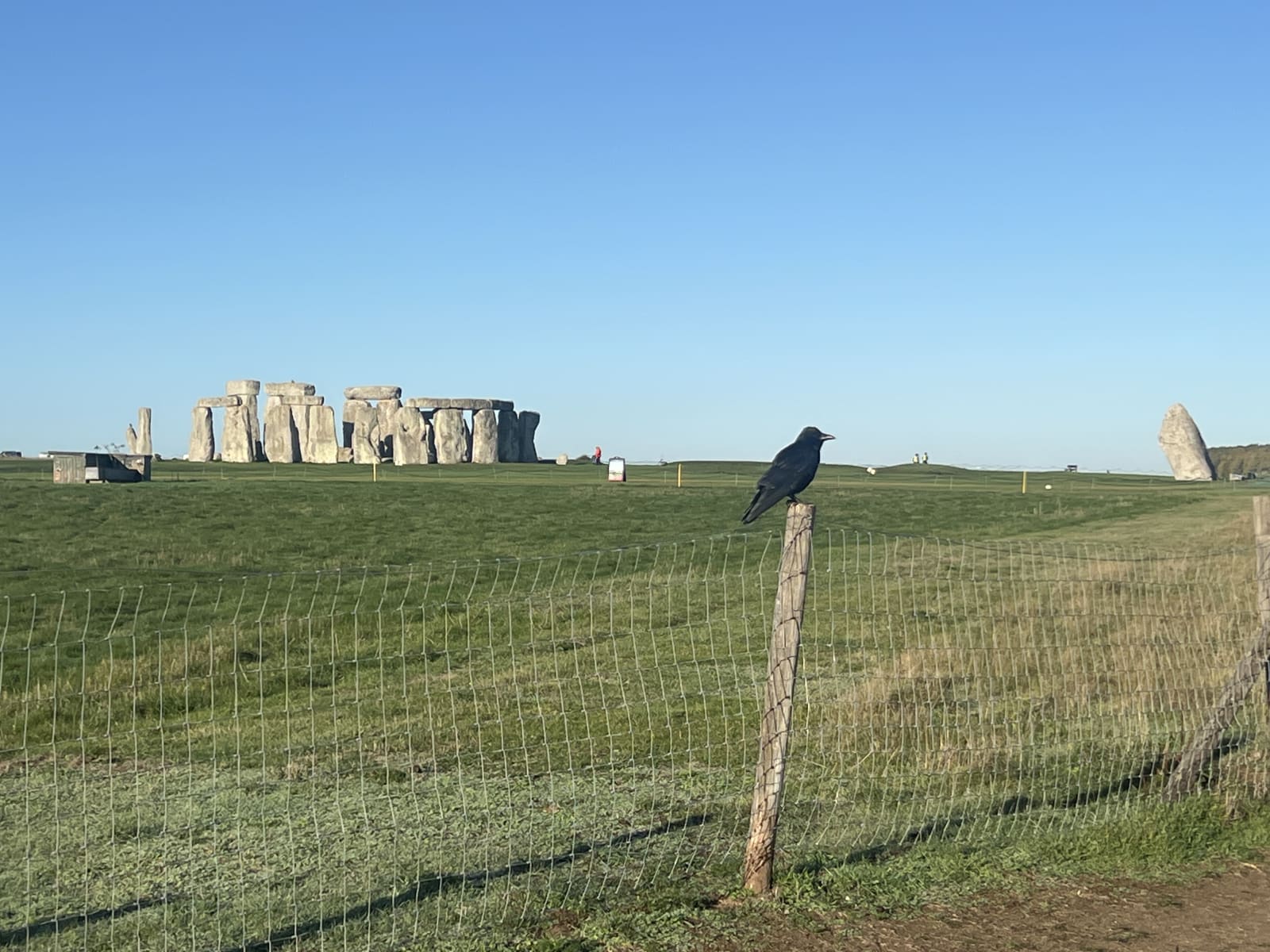
Just me and this crow contemplating how weird life is. They make us pay money to look at something that’s just hanging out here in nature for free.
What to put in your GPS
- GPS coordinates: 51.192523, -1.823215 — Fargo Road / Willoughby Road
- GPS coordinates where the vans park: 51.182031, -1.828076
Heads-up: don’t trust your GPS on this one
My GPS brought me to the main Stonehenge Visitor Centre car park wanting to send me down the road toward the stones from there.
That road is blocked to cars because obviously they want you to buy an expensive ticket and pay to get in. It’s now only used by the paid shuttle buses, so unless you’re buying a ticket, it’s a dead end.
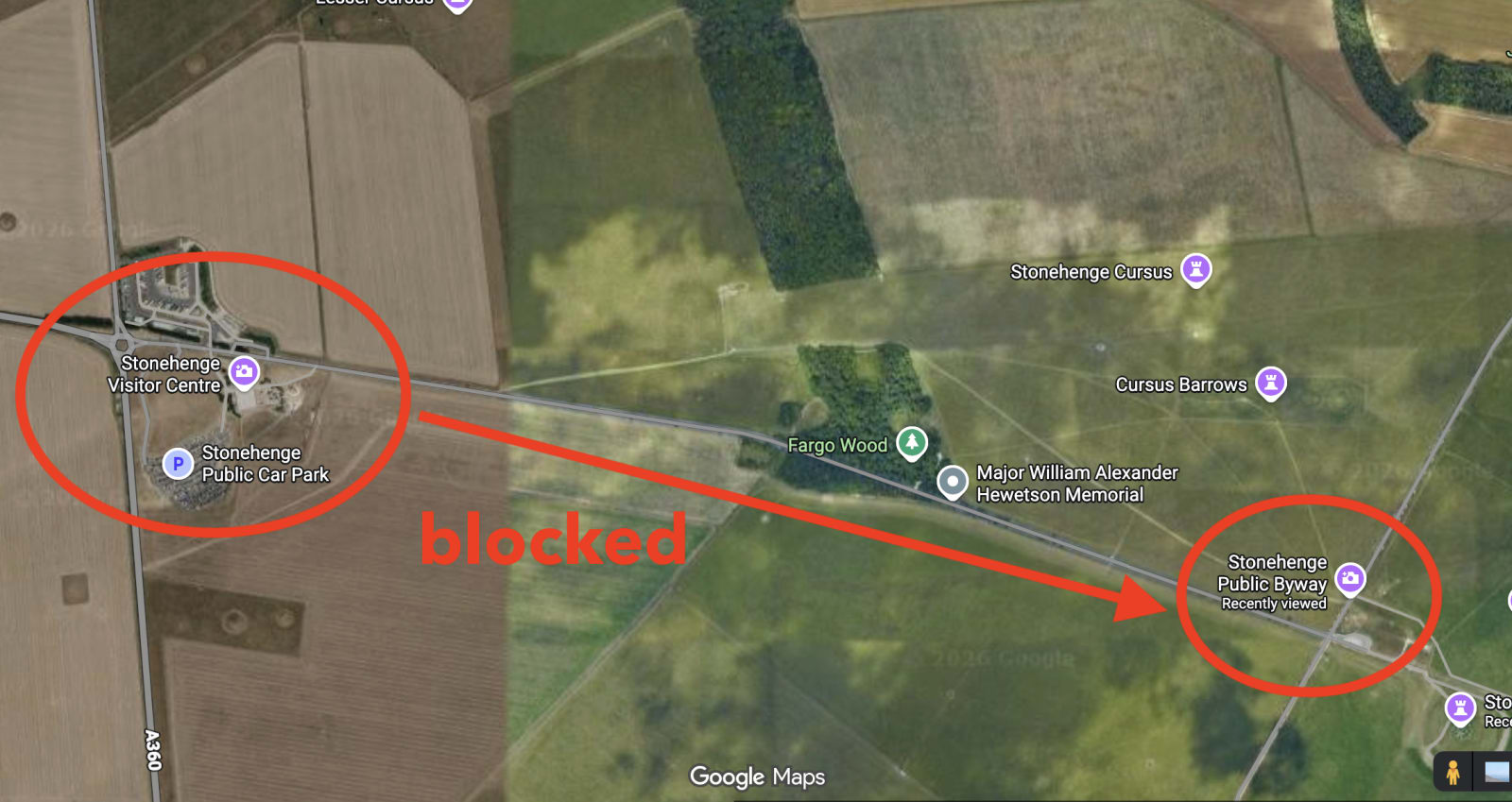
The route my GPS wanted me to take. The road from the visitor centre to the byway is blocked.
Instead, head north from the visitor centre roundabout on the B3086 up to The Packway. Turn right and follow The Packway east toward Larkhill, then turn right again and head south down Willoughby Road. That takes you onto the byway and down to where the vans park.
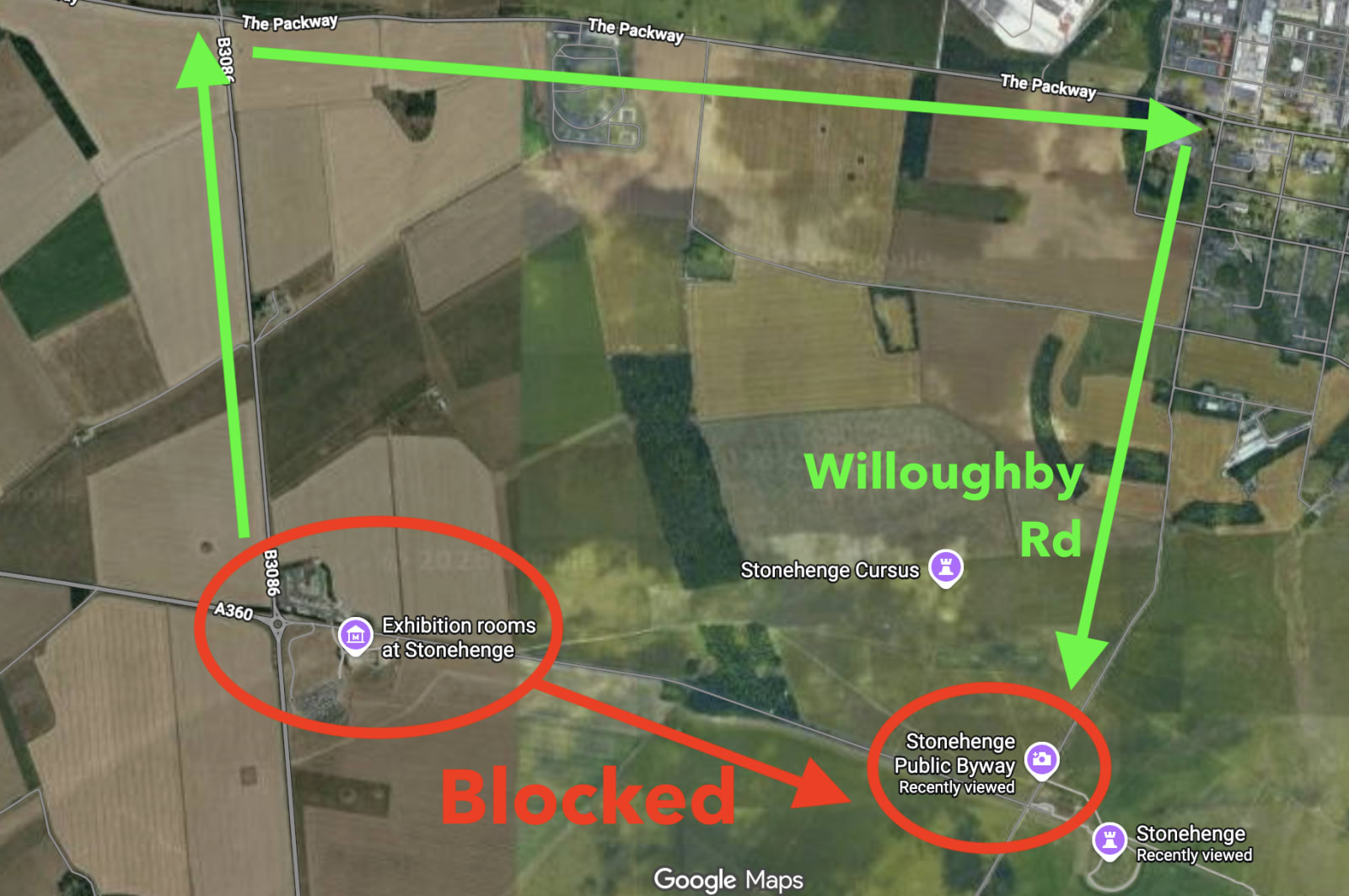
The way that works: up to The Packway, across, then down Willoughby Road.
Parking
You have two choices:
- Park at the north end at Fargo Road and walk south along the byway for about 1.1 km — roughly 15 minutes.
- Drive down the byway (when it’s open to vehicles) and pull onto the verge where the other vans are. This is what most people do. You’ll be a few hundred metres from the stones with a clear view from your seat. This road is gravel and potholed, but honestly not too bad.
Park on the verge, leave room for other vehicles to pass, and don’t block field gates.
Getting close to the stones
Walk on the byway toward the stones. Just before you reach the main gate where the shuttle bus drops off paying visitors (there will likely be a worker there wearing a hi-vis vest), turn left onto the public footpath that runs literally right beside the regular entry path.
Paying visitors still cannot go inside the stones (unless they pay some exorbitant fee like these folks below). They’re kept back on a roped-off pathway and from the free path you’re only a little further back.
Looks like some rich folks sprung for the extra cherry on top and paid more to be up inside the stones. I’ve met people who said they used to hang out here and wander all over for free growing up. Capitalism.
Option 2: Straight off the A303
The same byway also meets the A303, so you can turn onto it directly from the main road. It’s the quickest way in, but it’s the trickiest to drive safely, so be careful.
Important: you can only turn in from the eastbound side (a left turn). There’s no right turn allowed from the westbound lanes, and there’s no turning lane to wait in. So:
- Coming from the west (Exeter, Devon, Cornwall): you’re already heading the right way. The turn is on your left.
- Coming from London or Amesbury (heading west): drive past the stones, continue to the next roundabout (Longbarrow roundabout, where the A360 meets the A303), go all the way around, and come back east.
What to put in your GPS
- Approximate GPS coordinates of the turn off if you’re hading east: 51.176104, -1.832596
How to make the turn
- Heading east, pass the Longbarrow roundabout. Keep going for roughly a mile. Once you top the rise, watch for the turn on your left.
- The turning is unmarked. Your best landmark is the line of vans parked along the track — they’re visible from both directions and warn you the entrance is coming.
- Slow down early and put your hazard lights on. Drivers behind you won’t necessarily be expecting anyone to turn here.
- Turn left onto the byway, pull onto the verge and park.
- Then walk north along the byway for about 500 m with the stones on your right.
- Walk past the shuttle bus drop-off gate, then turn right onto the public footpath. It runs alongside the paid area and brings you back to the stones.
NOTE: Don’t try to cross the A303 on foot. The byway does continue south across it, but there’s no safe crossing.
Option 3: Just drive-by on the A303
The fastest free option is just to glance from the car going by. The A303 passes right by the stones, so you can see them without stopping at all. It’s also the main route from London down to the southwest, so it’s busy, and with everyone rubbernecking at the stones, traffic often backs up.
What to put in your GPS
You don’t need a destination; just route along the A303 between these two roundabouts:
- East end: Countess Roundabout, Amesbury (where the A345 meets the A303) — 51.1773865, -1.7805129
- West end: Longbarrow Roundabout (where the A360 meets the A303) — 51.1716606, -1.8588057
- The stones themselves: approx. 51.1767106, -1.8264751, if you want your map to show you when you’re close
The stones sit just north of the road. Heading west (from London/Amesbury), they appear on your right after you drop down into the dip and climb back up. Heading east, they’re on your left.
Expect the “Stonehenge slowdown”
Traffic almost always crawls as it passes the stones because everyone is looking for them, so be careful!
Two more free options worth knowing
Walk in from Woodhenge
If the byway is closed to cars, or you’d rather stretch your legs, park for free at Woodhenge and walk to the stones across open grassland. It’s about 2 miles (3 km) each way.
- GPS coordinates: 51.1899218, -1.7849923
The route takes you past Old King Barrows (Bronze Age burial mounds) and along The Avenue, the ancient earthwork thought to be the ceremonial approach to the stones. On the way back you can loop past the Stonehenge Cursus, an earthwork built several hundred years before the earliest phase of Stonehenge. The Woodhenge car park is small and often fills up, and there are no toilets or refreshments along the route.
Go for a solstice
Twice a year, English Heritage opens the stone circle itself for free, and you can walk right up to the stones, something even paying visitors normally can’t do. Expect thousands of people and a very early start. Only trust the official English Heritage site for solstice times.
How to do it safely (and keep it free for everyone)
The free byway access is controversial, and the main argument for closing it is damage and mess (and, ahem, capitalism!). Every visitor who leaves it cleaner than they found it helps keep it open.
Honestly, capitalism reigns, people. They will try to find any way they can to keep us from enjoying nature for free! I know if you’re reading this you’re probably not part of the problem but please be considerate!
- Stay on the public paths. The free footpath and the byway are public rights of way. The fenced area around the stones is the paid zone, don’t climb or cut through fences.
- Don’t cross the A303 on foot. The traffic is fast and there is no safe crossing.
- Turn in and out slowly. When you’re coming off the A303 slow down and give other drivers time to react.
- Park considerately. On the verge, never blocking the track or a gate. Leave room for others to pass.
- Pack out everything. There are no bins. The National Trust specifically cited fly-tipping and latrine pits along the byway in its push to ban vehicles. Don’t be part of that story.
- Be aware of the military. The north end of the byway is near Larkhill army camp, and Salisbury Plain is used for training. Obey any signs or red flags.
- Respect the people living there. Some of the vans on the byway are people’s homes. Don’t photograph people or their vans without asking.
- For god’s sake leave the sheep alone! It frustrates the hell out of me when people walk around with way too much audacity. There are farmers’ fields full of sheep right next to Stonehenge. There are clearly cut paths in the fields. But idiot tourists go wandering around wherever they feel trying to get photos with the sheep. I saw a sheep eyeing me warily in the early hours and didn’t think much of it (I was on the other side of the fence) but now, goodness, what these poor sheep must have to deal with day in and day out!
What it costs to go in Stonehenge (and what you get)
An adult ticket costs about £27 booked online in advance, or £32 if you buy on the day. English Heritage says booking early saves up to 15%, and the advance discount ends at midnight the day before your visit.
| Ticket | Price |
|---|---|
| Adult, booked online in advance | £27.03 |
| Adult, bought on the day | £31.80 |
| Family (1 adult + up to 3 children) in advance | £40.54 |
Parking at the visitor centre is free if you have a ticket. Opening hours are 9:30am to 5pm, last entry 3pm. If you plan to visit lots of English Heritage sites, membership starts from £44 a year and gets you into Stonehenge free.
What the ticket gets you
- The stone circle path. You walk the path around the stones, getting within about 5 meters of them. You don’t go inside the circle; that’s a separate, pricier (of course!) Stone Circle Experience.
- The exhibition. More than 250 finds dug up in the area, from jewellery and pottery to tools and human remains. A lot of them are borrowed from the Salisbury and Wiltshire museums.
- The face of a 5,500-year-old man. Experts rebuilt his face from remains dug up close to the stones.
- Neolithic houses. Reconstructed homes showing how the builders may have lived, plus a chance to try moving a replica sarsen stone.
- The shuttle bus from the visitor centre to the stones (or a roughly 30-minute walk across the fields).
- A café and gift shop.
My take: watch a documentary, then go see it for free
The paid ticket gets you two things: a slightly closer view of the stones, and the story of the stones. You can get the view for free from the byway. You can get the story for free too, just in a different order.
Watch a good Stonehenge documentary the night before (or listen to one on the drive in). Then park on the byway, walk the free footpath, and stand there knowing what you’re looking at. You’ll get most of what the exhibition gives you, and you’ll keep £30 in your pocket.
That said, if you love museums, are travelling with kids, or want to see actual artefacts and that reconstructed face up close, then it makes sense to buy a membership to the National Trust or English Heritage so that you’ll be able to see dozens of other sites for free all year long.
If you’re in the area for longer, Avebury, north of Stonehenge, is another option: a whole village inside giant stone circles that you can walk among and touch, with no entry fee.
Any other questions?
Did I miss anything? Or just want to say hi. Send me an email at mashon [at] liveworktravel.com.
I sometimes post things on YouTube: @liveworktravel.